Everyone in the company knows part of the number. Nobody knows the number.
Ask three people what the margin on a running project is and you'll get three answers. The estimator has the one from the bid, eight months old by now. The site manager has a feeling, based on how the works are going. Accounting has last month's, because this month's invoices aren't booked yet. The real number exists. It's just spread across a spreadsheet in commercial, a folder of supplier offers in procurement, a site diary nobody reads, and an ERP that closes on the 15th of the following month.
The standard fix has always been meetings. Monday coordination. The monthly review. The Friday call about a subcontractor invoice that doesn't match anything anyone remembers agreeing to. Every one of those exists to carry information between departments by hand. Not coordination, just the company compensating for data that doesn't flow on its own.
It costs money in a way that never appears as a line item. Decisions get made on the numbers available, not the numbers that are true. Extra work gets built before it's approved. The order goes to the worse supplier because the better offer was sitting in someone's inbox. The margin doesn't collapse. It fades, a percent here, a percent there, and surfaces in the final account, when the only thing left to do is explain it.
So this suite is built around one requirement: on any project, at any moment, you can see where you stand against the schedule and against the money. Without calling anyone, without waiting for month-end, without opening four systems. Not a dashboard bolted on top of the mess. One system where the bid, the orders, the site and the invoices are the same data, current because it's never retyped.
It grew out of years of building software inside a working construction company, replacing legacy tools, Excel files and email threads with systems shaped around how projects actually run. Every module ships by the same rule: less manual work than before, or it doesn't ship.
One per place the margin leaks
Bid Management
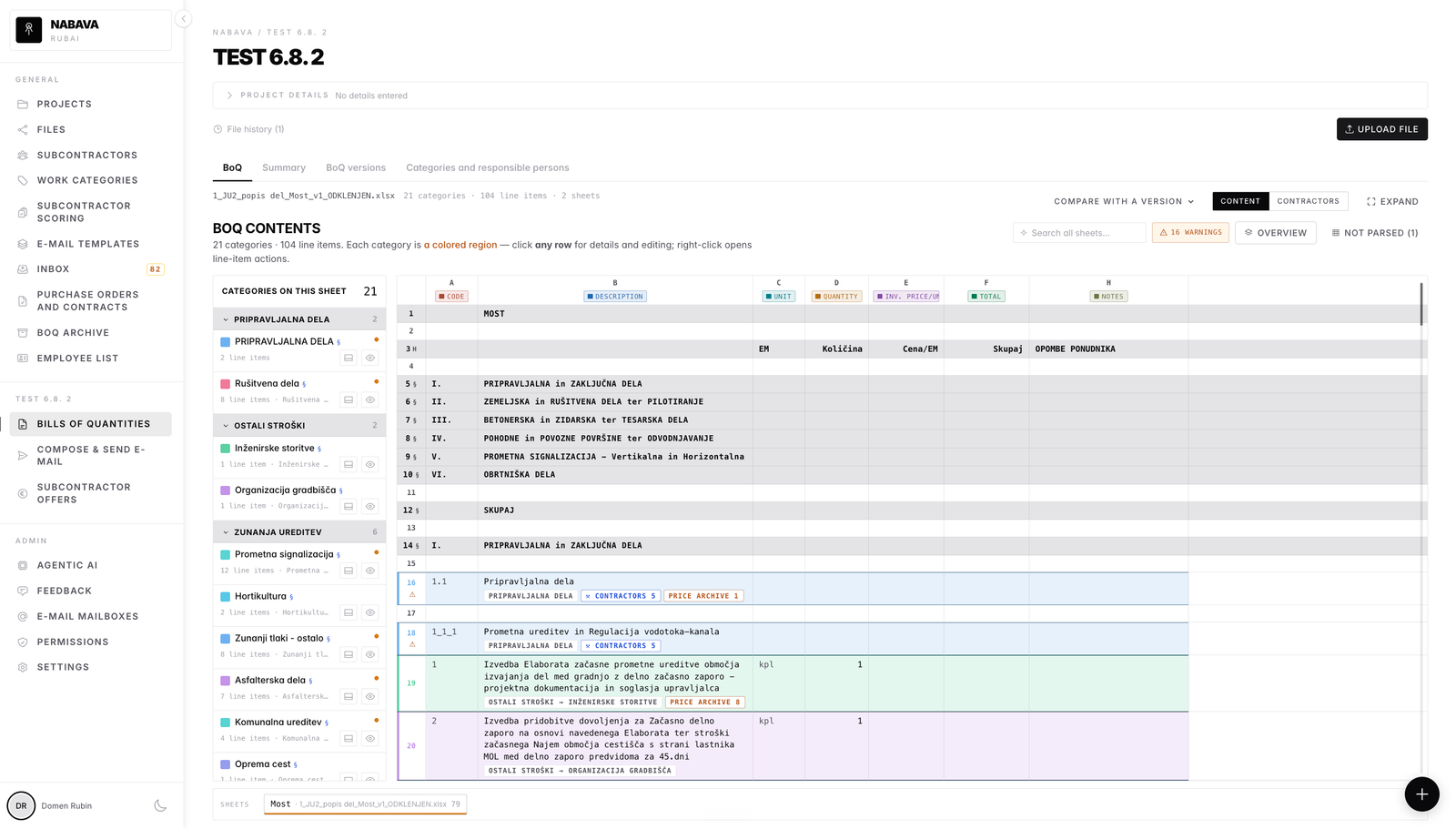
Winning work starts with pricing it right, fast. The module takes the client's unpriced bill of quantities, structures it digitally, and prices it from what similar positions actually cost you last time. Every estimate versioned, every price traceable.
- Unpriced BoQ in, priced bid out. No re-typing, no broken Excel formulas
- Prices pulled from your own completed projects, not gut feel
- Every bid versioned, comparable, and reusable for the next one
Field Operations
The site is where the plan meets reality, and where most of what happens never makes it back to the office. The module captures progress, changes and site records as a byproduct of work people already do, so the project's real status exists somewhere other than the site manager's head.
- Site records written once, filed where the office can find them
- Extra work logged the day it happens, not reconstructed at month-end
- Handover documentation assembled as you build, not in a panic at the end
Procurement
Every position in the estimate needs someone to actually build it or supply it. The module sends inquiries from the BoQ itself, tracks who opened, who replied and who's stalling, and compares offers line by line against the estimate, so you see coverage and margin before you commit, not after.
- Inquiries sent from the BoQ itself: same positions, no copy-paste
- Every offer compared line by line against the estimate and against each other
- Purchase orders and subcontracts generated from the offer you picked
Finance
By the time a project reaches accounting, the money is already spent. The module ties every invoice back to the order it came from and the position it was priced at, so margin isn't an end-of-project discovery. It's a number you can check on Tuesday.
- Every invoice matched to its order and its estimate line, automatically
- Project margin visible while the project is running, not at closeout
- One answer to "where do we stand", the same for the site, the office and the bank
What started as one document workflow became the operating layer for their projects.
Tosidos, a construction company, replaced its patchwork of legacy software and Excel files with these systems. Starting with a single site-documentation workflow and moving department by department until the software runs the operation.